
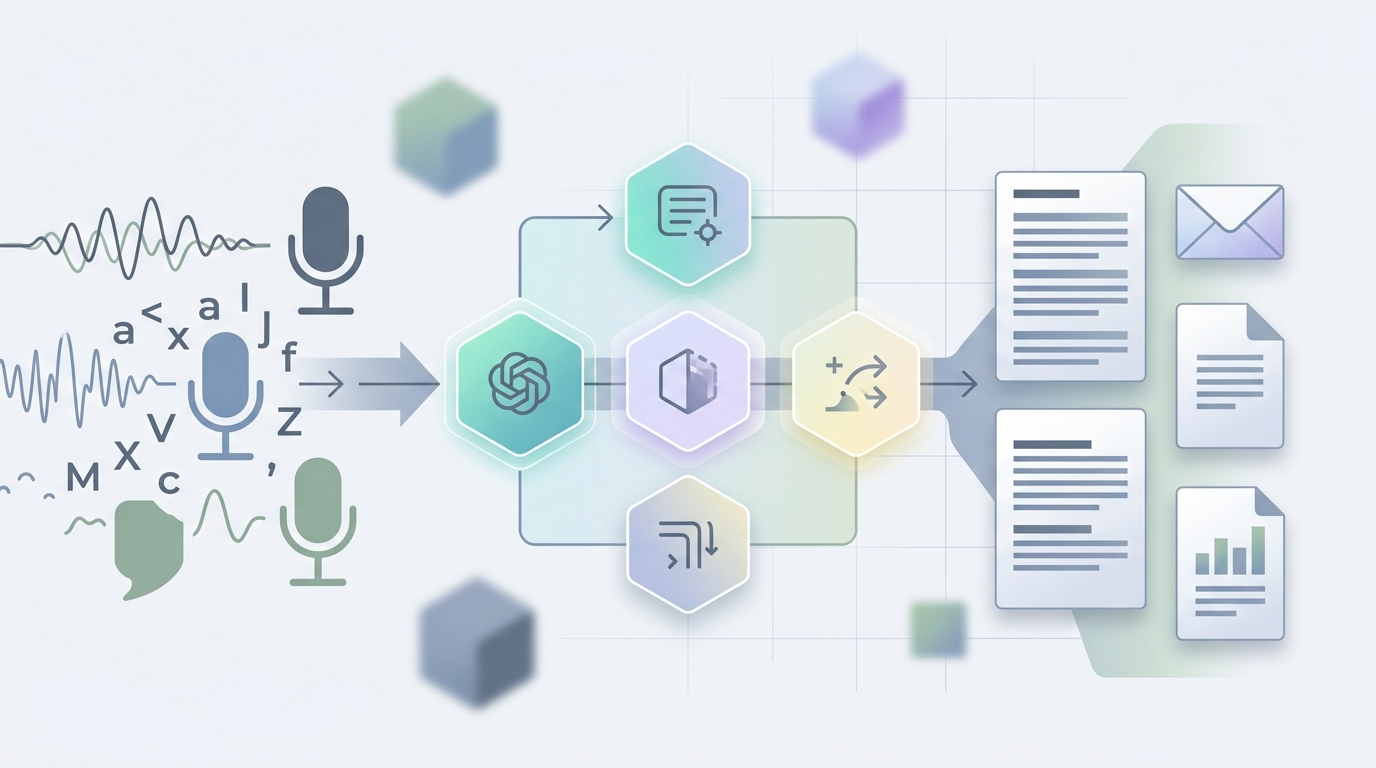
I've been using speech-to-text extensively for over a year now — it's become my primary input method for everything from blog posts to project documentation to client emails — and one thing that becomes obvious pretty quickly is that raw transcription output is rarely usable as-is. Even with excellent STT accuracy, you get filler words, false starts, meandering sentence structures, and text that reads nothing like how you'd actually write. The gap between spoken language and written language is wider than most people realise until they see their own words transcribed verbatim. So I built a collection of system prompts specifically designed to bridge that gap: the Text Transformation Prompt Collection, an abridged and rewritten version of my larger Text Transformation Prompt Library, focused on keeping prompts concise and immediately usable.
From cleanup to creative transformation
The collection covers a surprisingly wide range of transformations, from utilitarian to whimsical. At the practical end, there are basic cleanup prompts that fix transcription artifacts and typos while preserving your original meaning, and format-specific transformations that turn dictated notes into blog outlines, business proposals, meeting agendas, bug reports, press releases, classified listings, grocery lists, and even calendar entries in ICS format. The style transformations are where things get interesting: you can convert your text into academic tone, journalistic style, maximally formal business correspondence, or — if you're feeling particularly unhinged — Shakespearean English, Victorian aristocrat prose, or surrealist art descriptions. There's even one that randomly inserts ALL CAPS words for emphasis, which is less useful than it sounds but more entertaining.
Voice as an AI input method
The category I find most practically valuable is the AI-specific transformations. You can dictate a rough idea and have it transformed into a well-structured system prompt, a deep research query, code generation instructions, or a text-to-image prompt. This makes voice a genuinely viable input method for AI workflows — you talk about what you want, the STT captures it, and a transformation prompt reshapes it into the format the downstream AI tool expects. It's a pipeline that sounds complicated described in words but takes about five seconds in practice: dictate, paste into LLM with transformation prompt, copy the output. These prompts work with any speech-to-text tool and any LLM that accepts custom instructions. The repo is on GitHub.