
Anyone who has searched for remote jobs from outside the United States knows the particular flavour of frustration I'm about to describe. You find a position that sounds perfect. It's listed as "remote." You get excited, start reading the requirements, and then somewhere in the third paragraph — or sometimes buried in a tiny footer — you find "US only" or "must be within 3 hours of EST" or "candidates must be authorised to work in the EU." After getting burned by this pattern enough times while job hunting from Jerusalem, I decided to stop being annoyed and start being systematic. I created a structured taxonomy of these restrictions, cataloguing every flavour of not-actually-remote I could find. The result is my is_remote_friendly repository.
The anatomy of a "remote" job listing
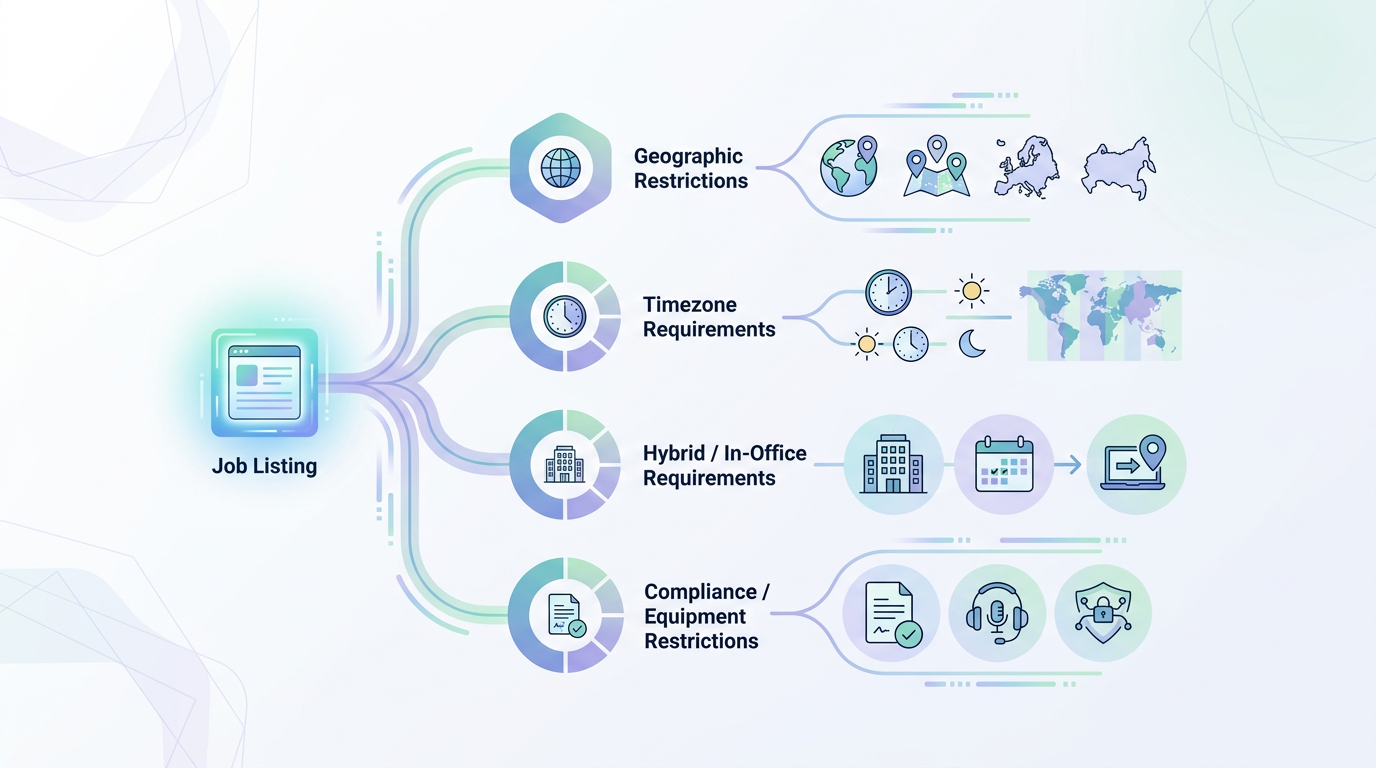
The taxonomy breaks down into three main categories, and the geographic restrictions are by far the most common and the most infuriating. US-only is the heavyweight champion of remote work caveats, excluding all international candidates regardless of qualification or timezone compatibility. Then there's EU-only for companies navigating European employment regulations, same-country-only for those avoiding international hiring bureaucracy entirely, specific state or province requirements that usually trace back to tax nexus concerns, whitelists of approved countries (typically a handful where the company already has legal entities), and the rarer blacklist approach of excluding specific nations. Each of these has legitimate business reasons behind it — employment law, tax compliance, data residency requirements — but the gap between what "remote" implies to a job seeker and what it actually means in practice is a genuine problem for the global workforce.
Beyond geography: the hidden requirements
Timezone restrictions form the second major category, and they're often more restrictive in practice than geographic ones. Companies either specify a required timezone directly ("must work US Pacific hours") or express it as a GMT offset range. For someone in IST (UTC+2), a requirement to overlap with US Pacific time means working until midnight or later, which is technically possible but not exactly the flexible remote work dream. Beyond geography and time, there are miscellaneous requirements that catch people off guard: minimum internet speed thresholds, background check requirements that may be impossible to fulfil in certain countries, data security restrictions mandating company-issued devices or prohibiting work from public networks, occasional on-site visit mandates ("remote with quarterly team meetups in San Francisco"), and equipment provisioning policies that only ship to certain regions.
Why I bothered classifying all this
The data is available in both CSV and JSON formats, making it easy to integrate into job search tools, browser extensions, or analysis pipelines. My original goal was personal: I wanted a simple classification system to quickly stratify companies by their actual level of remote-friendliness so I could stop wasting time on positions that would reject me based on geography alone. But I think it's useful more broadly. The word "remote" has been so thoroughly diluted that it's increasingly meaningless without qualifiers, and anyone job hunting internationally deserves better signal. If you're building a job board, a search filter, or even just maintaining your own spreadsheet of opportunities, this taxonomy gives you a standardised vocabulary for what companies actually mean when they say "remote." The full taxonomy is on GitHub for anyone who wants to use or extend it.