Living in Israel, I work with Hebrew text regularly. So when I started using AI image generation tools, a natural question came up: can any of these models actually render Hebrew text in generated images? Spoiler alert — most of them can't, and the failures are often hilarious.
I put together a systematic evaluation testing 12 major text-to-image models on two Hebrew words: שלום (shalom) — arguably the most famous Hebrew word — and פירגון (firgun), a less common word meaning "joy in sharing others' success."
The results
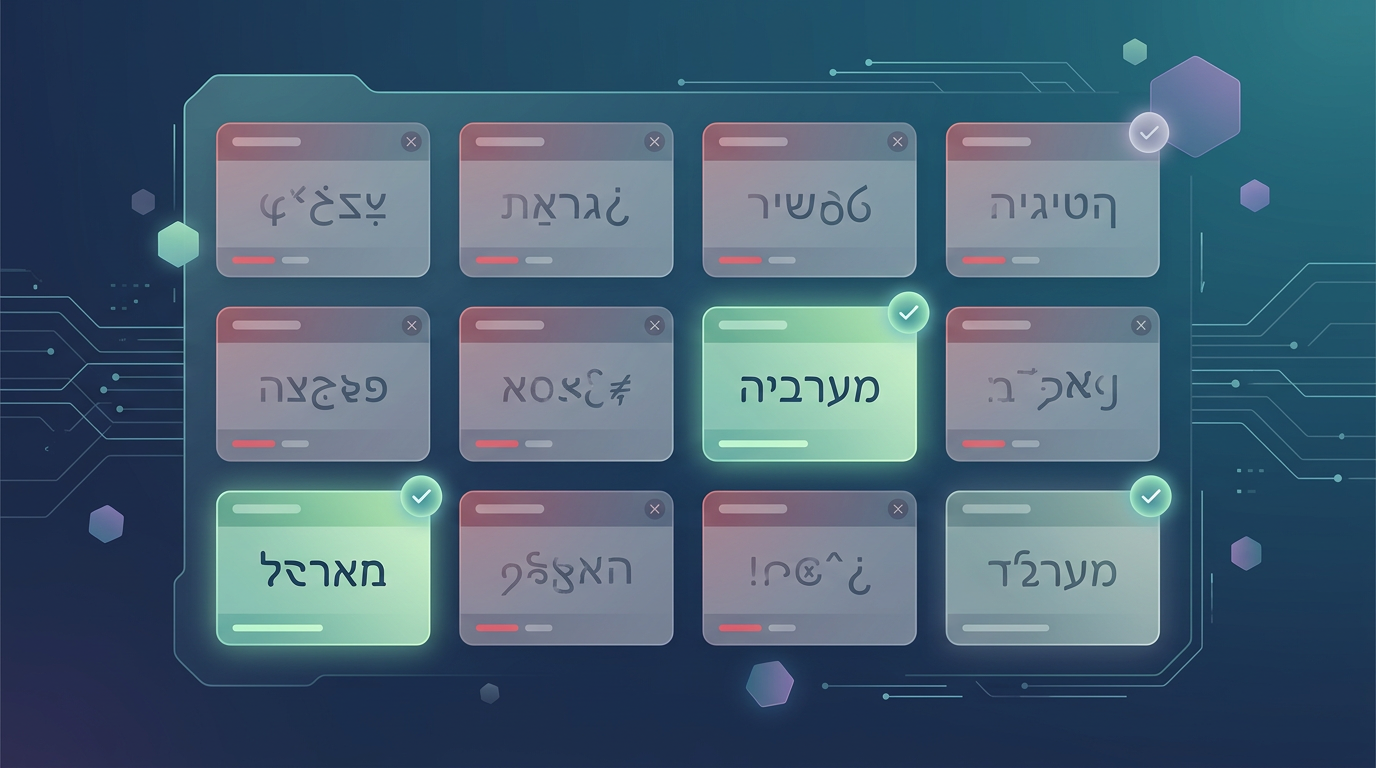
Out of 12 models tested, only Gemini 3 Pro and Nano Banana Pro scored 2 out of 2, correctly rendering both Hebrew words. Wan 2.5 managed a partial success with one correct word. The remaining 9 models — including Flux 2, Flux 2 Pro, Imagen 4, Ideogram V2, and Stable Diffusion 3.5 — failed on both tests.
Common failure modes
The failures were fascinatingly bad. Some models rendered Arabic or Russian instead of Hebrew. Others produced valid-looking Hebrew characters but assembled them into nonsensical words. Some mixed Hebrew letters with Latin characters. And a few generated Hebrew-like glyphs that don't actually exist in the script. Ideogram V2 gave me something that looked vaguely Russian, while Flux Dev went with Arabic script entirely.
Does prompt language matter?
I ran a second series using prompts written entirely in Hebrew to see if prompt language affects rendering accuracy. The answer: not really. Models that succeeded with English prompts also succeeded with Hebrew prompts, and vice versa. The underlying capability (or lack thereof) is what matters.
Takeaway
If you need Hebrew text in generated images, Gemini 3 Pro and Nano Banana Pro are currently your best bets. Gemini even showed contextual understanding — it added relevant thumbs-up emojis for the word פירגון, which was a nice touch. The full evaluation with sample images is available in the GitHub repo.