There's a category of AI models that I've been tracking closely that doesn't get nearly the attention it deserves: audio multimodal models. Not traditional speech-to-text systems like Whisper that convert audio to text and call it a day, but models that process audio tokens natively alongside text prompts, enabling capabilities that are fundamentally impossible with a transcription pipeline. I've been building a comprehensive resource repository to catalog this emerging space, and the more I dig into it, the more convinced I become that these models represent the next evolution of voice AI.
What makes these fundamentally different from STT
The traditional ASR pipeline works like an assembly line: audio goes into Whisper, you get raw text out, then you feed that text into GPT-4 or Claude for formatting, summarization, or analysis, then you post-process the output. It works, but it's clunky, lossy, and expensive. Every step in the chain introduces latency and potential errors. Worse, the moment Whisper converts audio to text, you lose everything that wasn't words: tone of voice, emotional state, accent patterns, pauses, emphasis, background sounds.
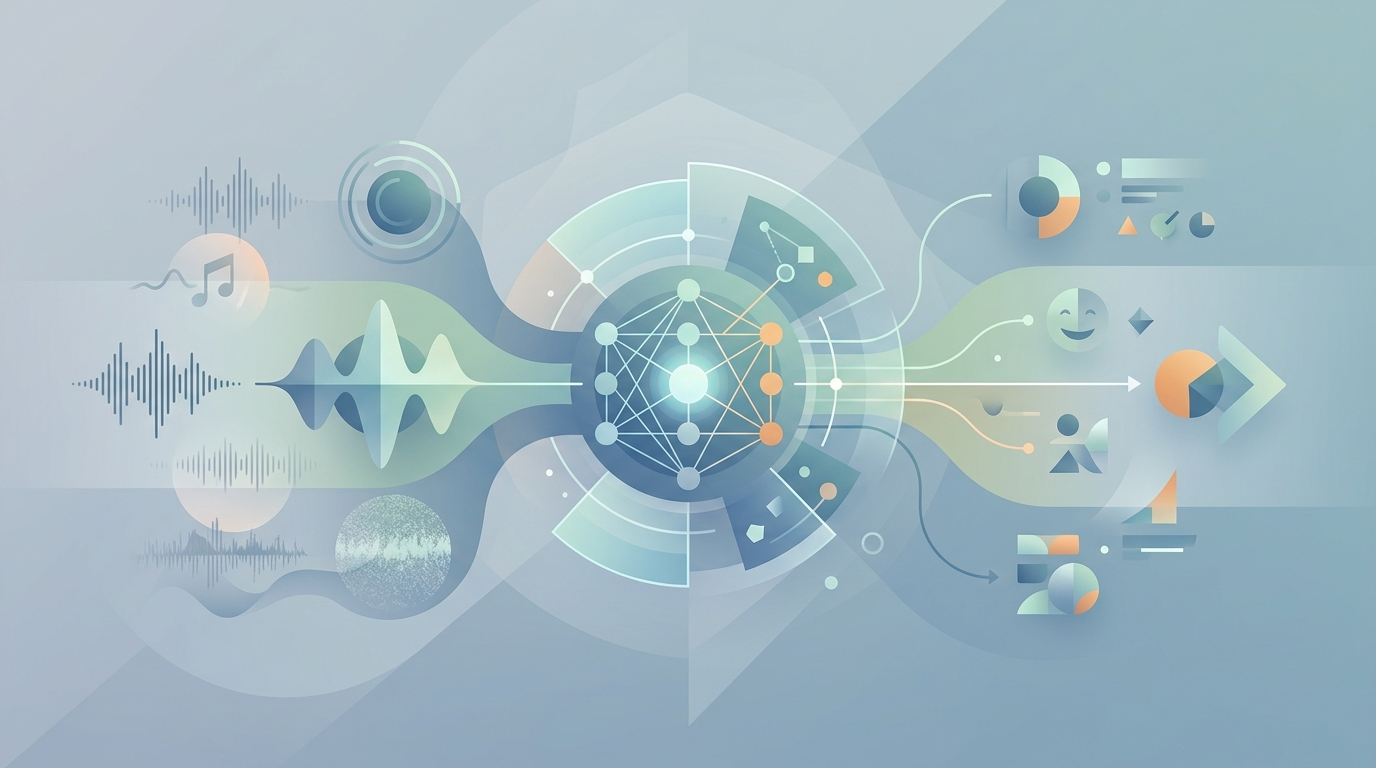
Audio multimodal models collapse that entire pipeline into a single inference call. You send audio plus a text prompt, and the model processes both natively --- the audio isn't transcribed first, it's understood directly as audio tokens alongside your text instructions. Want a formatted summary of a meeting recording? One API call. Need accent identification? One call. Mood analysis from tone of voice? One call. The model isn't transcribing and then reasoning about text; it's reasoning about the audio itself.
The open-source landscape
I've been cataloging these models in the repository, and the open-source ecosystem is more vibrant than most people realize. On the audio-text-to-text side, standout models include Qwen2-Audio from Alibaba (8B parameters, Apache 2.0), Ultravox from Fixie.ai (scaling from 8B to 70B, MIT licensed), Microsoft's Phi-4-Multimodal (5.6B, MIT), Moonshot AI's Kimi-Audio (10B, MIT/Apache 2.0), and NVIDIA's Audio Flamingo 3 (8B, though non-commercial). Then there are the any-to-any omni-modal models like Qwen Omni (7B-35B) and Google's Gemma 3n (2B-4B effective) that handle audio as part of a broader multimodal capability set.
An interesting classification quirk: Hugging Face currently lists these under the "multimodal" category rather than "audio," which reflects their architectural difference from traditional ASR. The two relevant task categories are audio-text-to-text and any-to-any --- both worth browsing if you want to see what's current.
Evaluating true audio understanding
One thing I found lacking in the space was a good way to evaluate whether these models actually understand audio or are just doing fancy transcription under the hood. So I developed a set of test prompts designed to probe capabilities that are impossible without genuine audio comprehension. These include accent identification (can the model tell you where a speaker is from based on pronunciation patterns?), mood detection (can it pick up on fatigue, frustration, or sarcasm from tone rather than word choice?), non-verbal context analysis (can it interpret the meaning of pauses and speaking dynamics between multiple speakers?), and vocal parameter analysis (can it estimate speaking frequency ranges for audio engineering purposes?).
These test prompts are all in the repository and are freely available for anyone doing model evaluation. The goal is to distinguish models that truly process audio tokens from those that are essentially wrapping a transcription step internally.
What's in the repository
Beyond the model catalog, the repo includes quite a bit of supporting material. There are detailed profiles for each model with parameter counts, licenses, and developer information. A companies index maps which organizations are active in the space (Alibaba, ByteDance, Microsoft, Mistral, NVIDIA, Google, and others). There's a benchmarks section covering evaluation frameworks like AudioBench, MSEB, UltraEval-Audio, and lmms-eval. I've collected research papers, inference tools, demo implementations, and curated links to related awesome-lists. There's also an AI-generated analysis section where I used LLMs to produce extended research on topics like whether multimodal ASR will make traditional STT redundant (spoiler: probably not entirely, but the gap is closing fast).
Why this matters for voice technology users
As someone who uses voice technology extensively --- I dictate much of my writing, transcribe meetings, and generally interact with computers through speech as much as possible --- the implications of audio multimodal models are profound. Instead of chaining Whisper, a punctuation restoration model, a diarization model, and then an LLM for formatting, I can potentially send a recording to a single model with instructions like "transcribe this meeting, identify speakers, format as meeting minutes with action items, and flag any points where the speaker sounded uncertain." That's not science fiction; models like Qwen2-Audio and Ultravox are approaching this level of capability today.
The practical upside is enormous: fewer API calls, lower latency, reduced costs, simpler codebases, and capabilities that simply weren't possible when audio understanding meant "convert speech to text." I've tested some of these models with hour-long recordings and they handle the length surprisingly well.
The future of the space
Audio multimodal is still early. The model count is small compared to text LLMs or even traditional ASR. But the trajectory is clear: every major AI lab is investing in multimodal capabilities, and audio is a natural modality to integrate. I expect the number of open-source options to multiply rapidly over the next year, and I'll keep updating the repository as new models and tools emerge.
Browse the full resource list, evaluation framework, and model profiles: Audio-Multimodal-AI-Resources on GitHub.